The new Trafag standard in gas density monitoring
The 87x9 platform as a unified solution for emerging insulation gas mixtures
As the power industry transitions to SF6 alternatives, gas density monitoring must evolve to meet new technical and regulatory demands. Discover how Trafag's new 87x9 platform combines proven mechanical reliability with scalable monitoring capabilities, providing a future-ready solution for both conventional and emerging insulation gas mixtures.
Our whitepaper is also available as a PDF to download
Gas-insulated equipment is undergoing significant technical and regulatory change. New insulation gas concepts, stricter requirements for leak reduction and documentation, and the increasing use of condition-based maintenance are raising the demands placed on gas density monitoring systems.
The Trafag 87x9 platform has been developed as a unified technical basis for these requirements. It combines Trafag’s proven mechanical density monitoring principle with optional continuous density measurement in one scalable platform architecture.
The platform includes the 8719 mechanical gas density monitor as well as hybrid variants that combine mechanical switching with continuous density measurement. This enables deterministic switching for safety-related functions and, where required, analog or digital density signals for trend monitoring, documentation, remote supervision, and system integration.
At the core of the 87x9 platform is a density-based measuring system with a sealed reference chamber. This enables mechanical temperature compensation and ensures that switching behavior reflects the actual dielectric condition of the gas compartment, not local temperature fluctuations or transient pressure effects. The measurement principle remains consistent across the platform, while individual device variants are selected and calibrated for the defined gas type, mixture ratio, nominal density, and operating pressure range.
The 8719 provides deterministic mechanical switching based on the sealed reference chamber system. Hybrid variants extend this function with an independent continuous measurement path. This dual-path architecture maintains uncompromised mechanical switching while adding density data for trend analysis, leak detection, regulatory documentation, condition-based maintenance, and future predictive maintenance strategies.
With up to five switching points for mechanical monitors, up to four switching points for hybrid variants, switching accuracy of ±10 kPa at 20 °C, and a switching span of up to 250 kPa, the 87x9 platform enables precise and differentiated monitoring concepts. Modular service functions for testing, sampling, evacuation, and filling reduce intervention effort and leakage risk, while flexible mechanical and electrical interfaces simplify integration into different gas-insulated equipment designs.
The result is a technically robust gas density platform for SF6 and alternative insulation gas mixtures: deterministic where safety requires it, scalable where data is needed, and stable over the full equipment lifecycle.
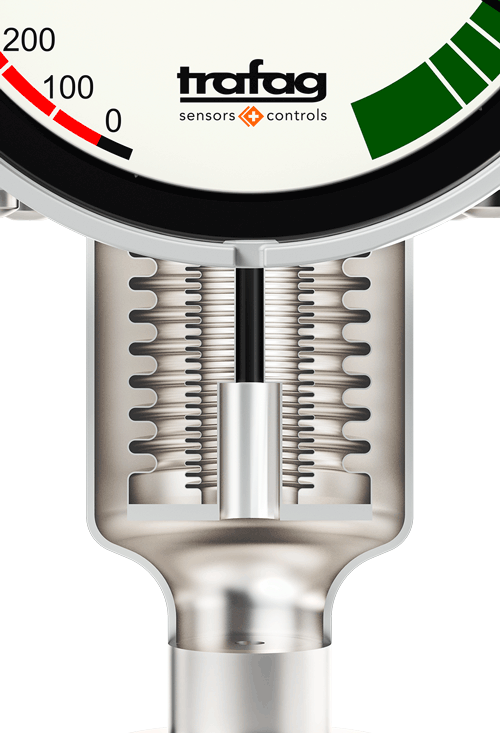
Gas‑insulated equipment is moving toward alternative insulating gases that operate at lower densities but significantly higher pressures than SF6. To meet these new requirements, the 87x9 platform introduces an improved reference‑chamber measuring system that builds on Trafag’s 40 years of experience and more than 35 years of proven reference‑chamber technology. The core principle remains unchanged because it continues to offer unmatched vibration resistance, long‑term stability, and the best switching‑point accuracy across the full temperature range.
What has changed is the capability of the reference system itself. The advanced reference chamber of the 8719 is engineered to handle absolute pressures up to 13 bar, enabling precise density‑based switching for both SF6 and modern alternative gas mixtures. These gases require substantially higher operating pressures to achieve equivalent insulation performance, and the new measuring system is designed specifically to accommodate these conditions without compromising accuracy or reliability.
Each device variant is calibrated for its intended gas type, mixture ratio, nominal density, and thermodynamic behavior. This ensures that the measurement principle remains consistent while the variant adapts to the specific properties of the gas. The result is a unified platform that maintains technical integrity across SF6 and alternative gases, reduces system complexity, and provides stable, reliable density monitoring even as insulation concepts evolve.
A key advantage of the 87x9 generation is that its reference chamber is always SF6 free, even when the device is used in systems that still operate with SF6. This simplifies end of life handling, as the reference chamber contains only gases that can be disposed of without special procedures. This is an increasingly relevant benefit as disposal regulations for SF6 continue to tighten.
The measuring system itself continues the proven reference chamber principle of the 87x6 generation, retaining the same critical design elements and manufacturing processes. Instead of being filled with the system gas, the new reference chamber uses a defined N2/CO2 mixture selected to reproduce the isochoric behavior of the intended insulating gas. During calibration, the switching points and display scaling are precisely matched to the properties of the specific gas mixture in the compartment. This allows each device variant to reflect the thermodynamic characteristics of its target gas while the underlying measurement principle remains unchanged.
Operational safety depends on reliable, clearly defined, and reproducible switching behavior. The 87x9 generation significantly expands the switching configuration range. Mechanical monitors can be equipped with up to five switching points, while hybrid variants support up to four switching points. This extended switching capacity enables more differentiated monitoring concepts, including pre-alarm, main alarm, interlocking, and overpressure functions. Compared with previous generations, this provides greater flexibility in defining system margins and safety responses.
With a switching accuracy of ±10 kPa at 20 °C and stable performance across the specified temperature range, the 87x9 platform delivers repeatable switching behavior under demanding operating conditions. The extended switching span of up to 250 kPa allows monitoring strategies to be defined with greater flexibility and robustness. In practical operation, this supports stable alarm thresholds, reduced risk of false alarms, and improved control of operating margins. The system does not only detect defined limits; it maintains the required switching behavior reliably under real-world conditions.
Gas density monitoring has expanded beyond its original role as a discrete alarm function. Modern gas‑insulated equipment must demonstrate stable operation, document gas handling, and provide traceable evidence that gas compartments remain within defined limits throughout their service life. At the same time, maintenance strategies are shifting from fixed intervals toward condition‑based and predictive approaches, which depend on reliable long‑term density data. Slow leakage, abnormal density trends, and deviations from expected behavior must be detected well before they reach alarm thresholds. The 87x9 platform addresses this through a common mechanical architecture with scalable monitoring depth.
The 8719 provides deterministic mechanical switching based on the sealed reference chamber system. Hybrid variants extend this foundation with an additional, independent measurement path for analog or digital output. This allows continuous density information to be provided without altering the underlying mechanical switching behavior.
The continuous measurement path does not replace the mechanical switching system. It complements it. Mechanical switching remains responsible for defined safety-related thresholds, while continuous measurement provides the density signal required for monitoring, diagnostics, and system integration.
All variants share the same core mechanical architecture. This supports consistent interfaces, predictable functional behavior, and simplified integration across different applications. Monitoring depth can therefore be scaled from discrete switching to continuous analog output or digital communication without changing the fundamental density-based protection principle.
This architecture is particularly relevant for OEMs and operators who need to support different gas concepts, monitoring philosophies, and system integration levels within one coherent platform structure.
Long-term stability is a fundamental requirement for any density-based monitoring system, especially in gas-insulated equipment designed for multi-decade operation.
The 87x9 platform achieves this through a combination of mechanical design, material selection, and Trafag’s sealed reference chamber architecture. The reference chamber maintains its internal conditions over the lifetime of the device. Because it is isolated from the process medium, it is not exposed to process-side contamination, moisture ingress, or gas-specific aging effects.
This ensures that the density comparison remains stable even as process gas conditions, operating pressures, or application requirements change over time. The mechanical thermal compensation system is designed to resist fatigue, creep, and material drift. Components operate within stable elastic limits, supporting stable switching thresholds over long periods of temperature cycling and pressure variation. The geometry of the compensation system is designed to minimize sensitivity to local temperature gradients, so that switching behavior remains linked to true density conditions rather than short-term thermal effects.
In hybrid variants, long-term monitoring capability is extended by a quartz tuning fork sensor operating against a vacuum reference. The sensor provides a stable frequency-based measurement signal with minimal drift, delivering virtually drift-free performance over decades of operations. Depending on the variant, this signal is delivered as an analog output or as a digital Modbus value.
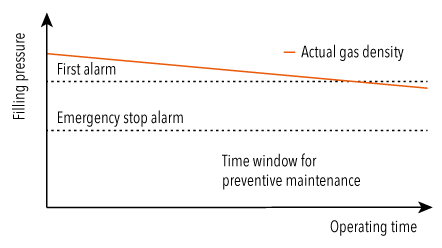
This continuous measurement path is fully independent from the mechanical switching mechanism. Safety-related switching behavior therefore remains uncompromised, while continuous density data becomes available for trend analysis, leak detection, and condition-based maintenance.
By detecting small density changes over long periods, the quartz sensor provides complementary information beyond the deterministic switching function of the mechanical system.
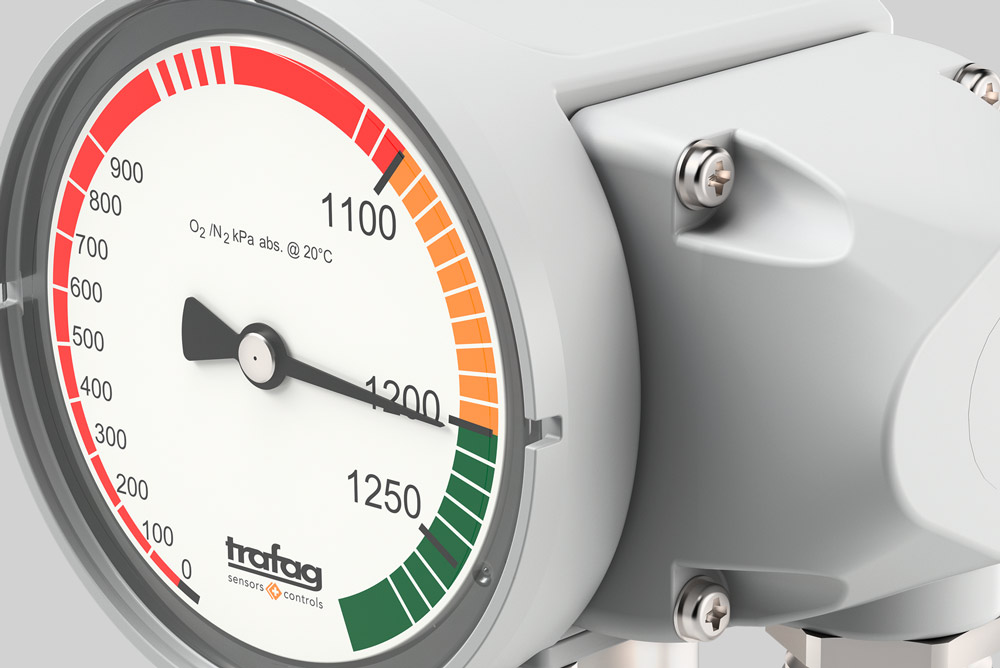
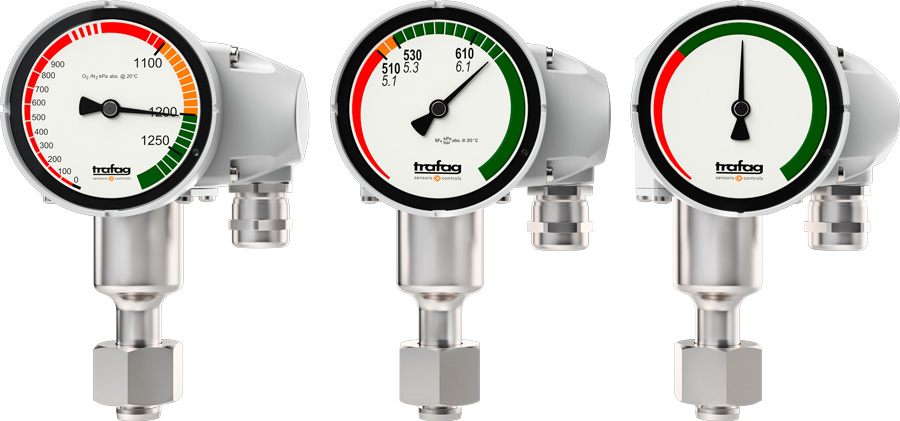
Precise switching is only effective if the operating state can be interpreted quickly and correctly in the field. A defining advantage of Trafag’s reference‑chamber‑based gas density monitors is the inherently “zoomed” display of the operating range. The scale presents the safety‑relevant region, extending from slightly below the lowest alarm threshold to above the overpressure alarm point,with noticeably higher resolution. This makes small deviations easy to recognize and supports fast, confident interpretation during commissioning, inspection, and maintenance. The low‑pressure region, which spans from vacuum to roughly 4 bar and is used during storage, transport, and early commissioning, remains fully visible but appears more compact so it does not distract from the operating condition. Compared with the previous 87x6 generation, the new 87x9 display introduces two notable improvements. The overall display is larger and visually aligned with the familiar layout of traditional pressure gauges, making it intuitive to read in the field. In addition, the low pressure region is no longer shown on a separate scale with its own pointer. Instead, it is integrated into a single full range display that combines the operating range, the low pressure range, and the intermediate region between them. This unified presentation provides a clearer overview of the entire density spectrum while preserving the high resolution focus on the operating condition.
In gas-insulated systems, every additional gas interface can increase leakage risk, service complexity, and installation effort. External valves, temporary test adapters, and device removal for verification introduce additional sealing points and increase intervention risk. With increasing requirements for functional testing and documentation of density monitors, service operations are becoming a regular part of the equipment lifecycle rather than occasional interventions.
The 87x9 platform addresses this by integrating service functions directly into the device. Depending on the application, testing, gas sampling, evacuation, and filling valves can be configured as part of the monitor. The valve options are modular and can be configured or omitted according to the application requirements. Their positioning is flexible, allowing installation-specific placement even in tight or complex mounting situations.
Routine verification can be performed without disassembling or removing the monitor from the gas compartment. This reduces sealing points, minimizes gas handling, and supports repeatable service procedures. The compact design also reduces installation space and shortens the mechanical lever arm between the device mass and the mounting point, which is particularly important during switching operations that generate strong vibrations. A shorter lever arm reduces mechanical loading, minimizing wear, preventing contact bounce, and improving long term functional stability.
Over the lifetime of the installation, this improves maintenance efficiency, simplifies regulatory testing, and reduces the risk associated with service interventions.
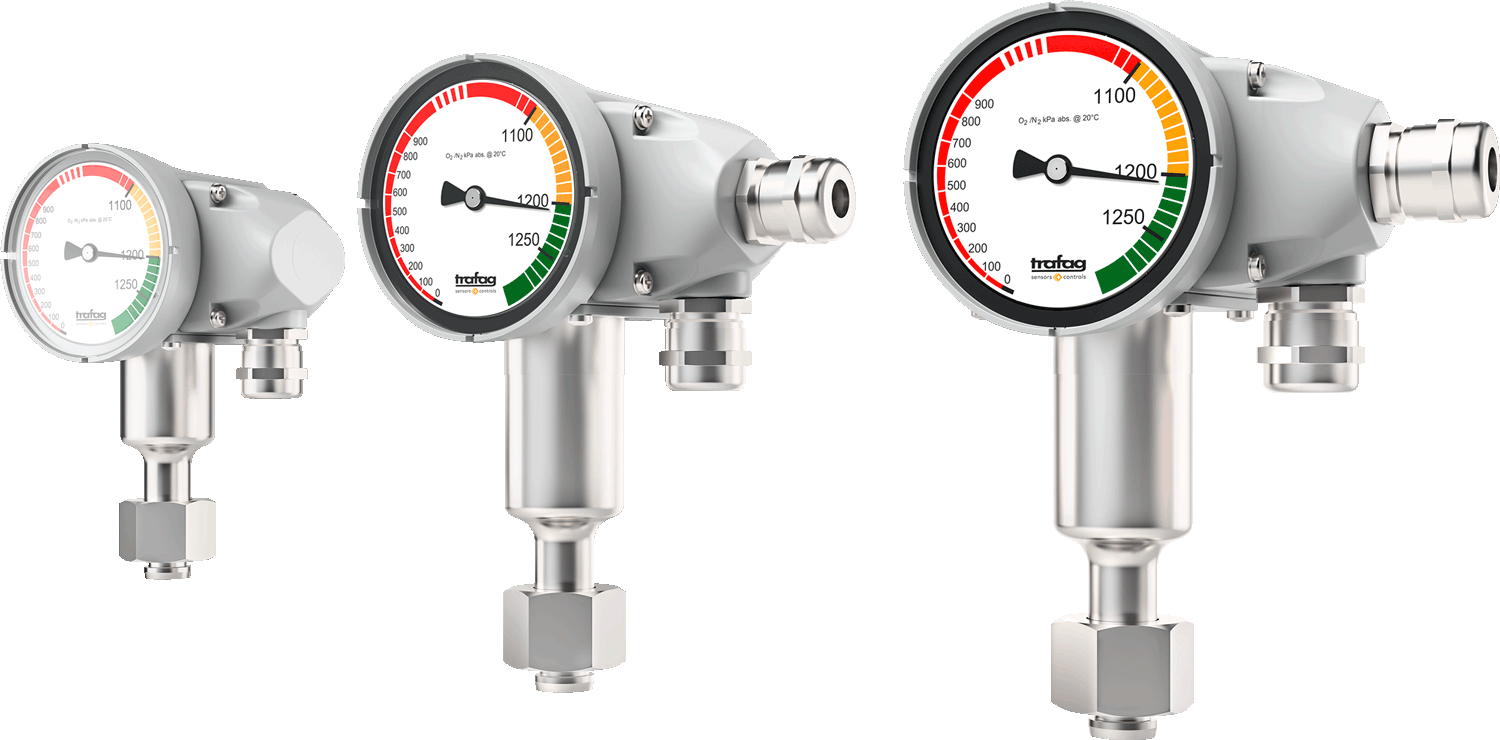
Installation conditions in gas-insulated equipment are often constrained by space, mechanical layout, accessibility, and cabling requirements. The 87x9 platform is designed to adapt to these constraints without changing the monitoring concept. Configurable gas connections and adjustable electrical interfaces allow the device to be integrated into a wide range of system configurations. This supports consistent implementation across different equipment designs while reducing the need for application-specific adaptations. The use of a separate connector housing enables cabling to be prepared independently of the device installation. Since cabling is often one of the most time-consuming steps during assembly, preassembly and testing of the wiring can improve installation workflows, reduce on-site effort, and support standardized production processes. This flexibility helps reduce installation variability and supports reliable integration even in compact or complex layouts.
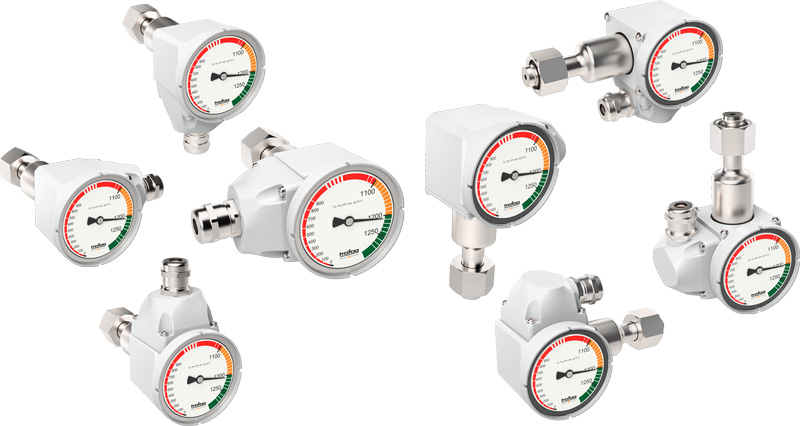
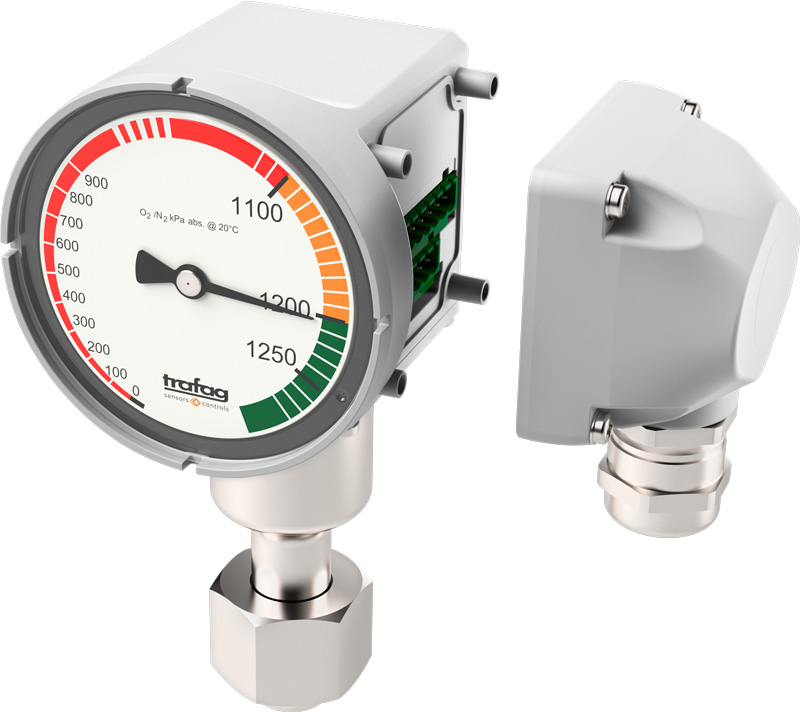
Installation conditions in gas-insulated equipment are often constrained by space, mechanical layout, accessibility, and cabling requirements. The 87x9 platform is designed to adapt to these constraints without changing the monitoring concept. Configurable gas connections and adjustable electrical interfaces allow the device to be integrated into a wide range of system configurations. This supports consistent implementation across different equipment designs while reducing the need for application-specific adaptations.
The use of a separate connector housing enables cabling to be prepared independently of the device installation. Since cabling is often one of the most time-consuming steps during assembly, preassembly and testing of the wiring can improve installation workflows, reduce on-site effort, and support standardized production processes. This flexibility helps reduce installation variability and supports reliable integration even in compact or complex layouts.
Key performance features of the 87x9 platform
| Switching points | Up to five for mechanical monitors; up to four for hybrid variants |
| Switching accuracy | ±10 kPa at 20 °C |
| Switching span | Up to 250 kPa |
| Measurement principle | Monitor: Density-based system with sealed reference chamber Sensor: Density-based system with quartz oscillator |
| Gas compatibility | Calibrated for defined SF₆ or alternative gas mixtures |
| Hybrid measurement | Independent continuous density measurement path |
| Output options | Analog or digital density signals, depending on variant |
| Service functions | Optional testing, gas sampling, evacuation and filling |
| Integration | Flexible gas connections, adjustable electrical interfaces and separate connector housing |